Who We Are: Colleen Deibel

 As part of a series we're calling Who We Are, we're working to build and connect our community by interviewing the talented, dynamic parents and staff who make up the people of Villa di Maria. Today, we meet Colleen Deibel, mother of three adorable little girls in Primary. Colleen is ever-smiling, has an easy laugh, and is an active member in the Villa di Maria community. Thank you, Colleen, for taking the time to share your thoughts and experiences in the Montessori world!Villa di Maria: What do you do (for a living, and also hobbies)?Colleen Deibel: I teach 7th grade science at Ladue Middle School. My area of expertise is in Life Science, but I also have a background in Horticulture. Gardening has always been a hobby; I used to do a pretty extensive vegetable garden, but with my three babies, I haven't been able to as much in the last three years. But this year I'm hoping we can do more.I also love to run.VdM: How did you get involved in Montessori?CD: I have a good friend how actually used to work here in the early 90's, a friend who went and started a Montessori school in Colorado, and two other friends were teachers. We also have tons of family involved in Montessori. But what got me here to Villa was when I was pregnant with my oldest. My cousin sent her children here, and encouraged me to check it out. I came and observed and just fell in love with it. It's just magical.VdM: What appeals most to you about Montessori?CD: I love that it's so layered. It's so respectful of who the children are. It doesn't put a limit on where they can go; it's so wide open. The way the materials flow, the way the classrooms are set up, and the way the Directress supports them, it's just beautiful.I teach in a traditional model, and I really believe that every child should have Montessori as their foundation. I think the possibilities for children, the potential, is so great. I get a chill just thinking about it. I think until you see it, you just can't imagine it.VdM: Can you share any instances where you've experienced "Montessori Moments" with your girls outside of school?CD: It's hard to say, because they've always done Montessori. But one thing I think Montessori is so good at is developing a child's natural curiosity and inquisitiveness and how receptive they are to knowledge. It's such an active type of learning, it's not passive in any way. For younger children, it's much more appropriate to be active within a structured environment.I think the wisdom of Montessori is starting to catch up and becoming more mainstream. Even traditional schools are moving towards this; the factory-model does not work anymore, it's not very responsive. I think science in particular is the type of thing that needs that hands-on, get-in-there type of learning. I love it here.VdM: What advice would you give a parent who is interested in Montessori?CD: I always tell people to just go observe. I send them the link, and tell them they have to see it themselves. I think spreading the information word of mouth is the best way to encourage others to explore Montessori.Thanks again, Colleen, for taking time out of your busy day to share your thoughts with us. You and your family bring so much joy to our community!


 We adults can tend to take for granted all that goes into preparing a meal: the manual dexterity it takes to open cans, for instance, or the skill of chopping onions. Observing these four children go through the process was a good reminder of the complexities involved in prepping a meal start to finish!
 Chopping onions, for instance, requires knife skills and strength, and a whole lot of persistence, especially when those strong onions begin to sting your eyes and make them water!
 Each child had the opportunity to attempt to open cans before allowing the expert of the group to take over. There was plenty of patience, guidance, and encouragement for those who struggled.


 And the onions...
 Oh, the onions!!!
 The children followed a recipe they had previously printed out, and checked back often to make sure they were following it closely.


 With guidance from Lower Elementary assistant Melinda, the children took turns with each step of the process to build their skills and understanding of the cooking process.


 And of course, the important last step before serving their delicious meal: cleaning up!
 They did an excellent job, and the entire Lower Elementary building was filled with wonderful smells of cooking sauce, spices, and onions. A large portion of the Lower Elementary classroom opted to pay for the meal from the money they have budgeted for the cooking program. Be sure to check back in for Part II!


 While the children enjoyed some (rather cold) outdoor time after lunch and recess, Directresses and Assistants worked hard to ready the classrooms with Chinese New Year decorations and Chinese culture items in general. Ms. Sophie did a wonderful job setting up a special surprise Kung Fu presentation by Mr. Qi Xing, who is from China and has practiced Kung Fu for over 30 years.


 The children were treated to the traditional Chinese New Year story of Nian; the highlight being Directress Anna Schwind reading a page in English, followed by Jie Zheng's reading in Mandarin. The children were absolutely captivated by the version in both languages!
 Soon after the reading, the surprise of the Kung Fu presentation was revealed. Clearly, these children were beyond excited!
 Mr. Qi Xing, who is a 32nd generation of disciples of Shaolin Temple in China, is particularly good at Shaolin boxing, Shaolin sword, and hard Qi Gong. He has earned many domestic and international Kung Fu Championships, and is now operating Qi Master at Kung Fu School in St. Louis. What an honor it was to see his presentation!

 When Mr. Xing asked for volunteers, the hands shot right up!


 After the presentation, Ms. Sophie discussed some traditions of the Chinese New Year before the children went on to do crafts having to do with the new year. Some favorites were coloring pages, paper fortune-tellers, and pop-up dragons. The staff really went all out with this one!


 The last part of the celebration was the food! Children enjoyed lotus candy, oranges, vegetarian spring rolls, dumplings, and fortune cookies.
 Happy Chinese New Year, the Year of the Rooster!


 Too often, learning is misrepresented. While healthy competition is just that, being one's best self is not to the exclusion of others.


 How wonderful it is to see children working together, testing each other, building each other up rather than pushing one another aside. How special to witness a collaborative decision-making process, even when it doesn't go smoothly. How important to teach our children to work together, so that they may do so gracefully as adults.


 The activities related to care of self, such as those having to do with dressing frames, buttoning, lacing, tying bows, hand-washing, and shoe-polishing help the child to become independent, self-reliant, and self-assured. These activities also increase control of movement, attention span, and concentration.Important to note is that each step is done in a sequence with each buckle as opposed to completing all steps with each buckle. For instance, the child will pull the strap from under the ring for each separate strap from top to bottom (as seen in the first photo) as opposed to completing the whole task with each strap separately, thus reinforcing each step and its repetitive movement as a part of the whole.
 "It may be said that we acquire knowledge by using our minds; but the child absorbs knowledge directly into his psychic life. . . . Impressions do not merely enter his mind; they form it. They incarnate themselves in him. . . . We have named this type of mentality, The Absorbent Mind."—Maria Montessori, The Absorbent Mind


 Megan Eilers, current Camp Pegnita Director and former camper, then camp counselor, took time to discuss a bit of the history of this special place. It is also worth noting that Megan has taken care of the binder full of Camp Pegnita paraphernalia with serious dedication; she has kept the pictures, brochures, and other artifacts in pristine condition, which is no easy feat, as some of them are from 1947! Below, Megan describes what she finds so special about Camp Pegnita."We had so many opportunities for free play. As campers, we would choose a place, then create our own games without anyone directing us. That was really special to us, and that is another tradition that continues today."
 Late 1940's Tug of war at Camp Pegnita
 Camp Pegnita has changed very little since the beginning, when Peggy Strauss purchased the property with her husband Milton. The original swimming pool, which was shaped like a whale, was removed seven years ago, and a new pool was built in a more favorable location, but aside from that, the grounds in 1947 were very similar to how they appear today.
 Here is the original pamphlet for Camp Pegnita from 1947! Note the tuition: $15 per week! Horseback lessons were the fair fine price of $1.25!
  The original camp wagon, the wheels of which were hung in the pavilion as chandeliers. They will now be repurposed into tables for the elementary outdoor spaces.
  The "Nature Hut," where Megan remembers discovering some interesting specimens... and you may recognize that totem pole on the left!More importantly, many of the camp traditions have remained. "What I love about this camp is that it wasn't, and isn't, a camp for just one kind of activity. As a child, archery was the biggest draw for me. I would strive every summer to get the 'Golden Arrow' award, which remains a camp tradition," shares Megan.
 Nowadays, children are offered Red Cross certified swim lessons and an on-duty lifeguard supervises swim time. Young children often solidify their underwater skills here, in addition to playing all sorts of water games with their friends!

 Originally, Camp Pegnita was an overnight camp (at least on the weekends). Now, children can sign up for a week at a time, or attend all summer long during the daytime hours. Each week, a specially scheduled event such as a luau, magic show, mad science demonstration, or camp-wide field day takes center stage. And though the particular themes have changed, the tradition of weekly themes remains an original feature since 1947!
 Though it feels like summertime is ages away, the sign-up for Camp Pegnita and Montessori Mornings is fast approaching. For the general public, it is February 1st, and it fills up fast! For Villa di Maria students, priority enrollment for Camp Pegnita and Montessori Mornings opened last week. If you have not received an email about this, please contact Hilary!Thank you, Megan, for sharing some history of Camp Pegnita. There will be plenty more reminiscing in the Winter Newsletter... so stay tuned!


 VdM: Can you share a bit about how your family got into Montessori education?Julia: This is my third year here at Villa di Maria. I started at another school in fourth grade. Before this, I was homeschooled, then tried a public school.Blaine: Laura, my wife, is an educator, and had been homeschooling both our girls. Our older daughter decided to attend public school for high school, so that's where she is. But we needed the next step for Julia. Laura took a very holistic approach to education, which is what I feel Montessori provides.Julia: I was struggling in school. It's really hard for me to read, but I'm good at math and science. I had trouble keeping up because they would switch subjects so fast; we were only allowed 45 minutes per subject, so we only learned one or two parts of it. I had trouble understanding what was going on.Blaine: The problems were compounded because Jules is so good at math, so good at science, but she was falling behind because of the reading. We had known about Montessori through my wife, who had been involved in Montessori as an educator through the years. We thought that given our daughter's needs and desires for education, this seemed like the perfect next step, and it has been.I wish my parents had known about Montessori when I was a child. I think there's this impression to the outsider about Montessori that it's easier or slower, or a free-for-all, but it's really quite the opposite! To give outsiders the amazing examples like MMUN, and the fact that they are working on some pretty advanced stuff; not only is it advanced, but it's self-directed. They're absolutely motivated to do it. I truly wish this had been available to me as a child!VdM: Thank you, Blaine and Julia, for sharing your story of Painting for Peace and also your take on Montessori education.


 It was lovely to talk, laugh, and catch up with the Villa community post-holidays, and a perfect reminder to be grateful for the amazing people who make up this place. There were introductions and speeches to commemorate the milestones Villa di Maria has achieved, as well as the brilliant future we strive towards.The future, which includes necessary campus growth to support our expanding population of children, is upon us! We have witnessed the growth firsthand as we drop off our children every morning and note the (amazing) daily progress of the


 A special thanks to Maria Burr and Michaela Herbst, who pulled together the event so seamlessly! It was a wonderful success!And be sure to watch the beautiful video by our own Tim Gebauer about the Capital Campaign


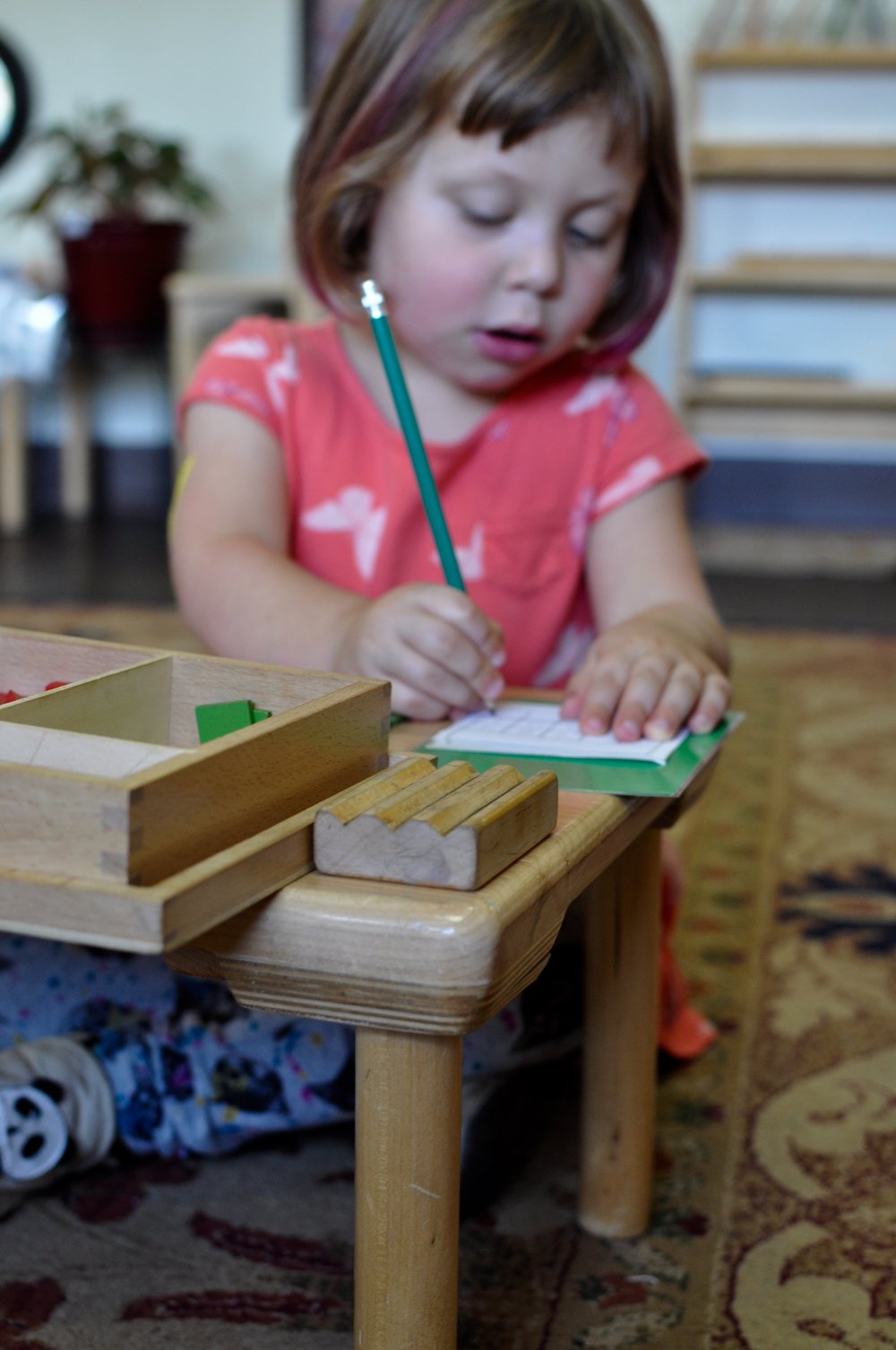 Stamp Game itself has evolved since Dr. Maria Montessori originally developed it. Dr. Montessori created the game using actual postage stamps (as collecting postage stamps was popular in that time), then gradually phased out to mosaic tiles, and finally, the wooden tiles that you see today.
 The first column is where the child writes the units; the second column tens; the third column hundreds, the fourth column thousands. After the directress writes a number, she will then read the number as, for example, if the number is 3289, 9 units, 8 tens, 2 hundreds, and 3 thousands. The directress will then read the number 3289. So much can be learned with stamp game, including abstract thinking, mathematical operations, coordination (those tiles are tiny, and look at the pencil grip!), order, and sequence, to name a few. Besides, it is fun, evidenced by the children's desire to do the work over and over again.


 Thank you, Rebecca, for sharing this piece of the Montessori world with us! It is truly a wonderful, meaningful process for all!


 The children took turns coming up to present Jess with a book (and there were plenty of extras for those who didn't get a chance to bring one in). Every child had the chance to give, and all were engaged and excited to see what Baby Jente's home library will contain!


 This was also a good opportunity to celebrate Jess, who has brought so much calm, positive energy to the P1 classroom on a daily basis. She will be greatly missed while she is gone, but the children and staff are so happy for her, her husband, and her growing family! Good luck, Jess, and we can't wait to meet your little one!

 The Primary classes started the concert with 8 songs, accompanied by the ever-patient Nathan Jatcko. The children clearly enjoyed sharing the songs they have been singing in class nearly every day for the past month!


 After the Primary performance, the Lower Elementary classrooms joined in singing and reciting poetry, quite impressive were the poems about the Mobius strip and Fibonacci numbers.In-between set changes, former Primary Directress (and current Director of Education) Robyn Milos and Lower Elementary Directress Meghan Moffitt Eilers gave touching speeches about their own girlhood experiences at Villa di Maria, true testaments to the special draw this space has on people well beyond the elementary years. It was a delight to hear some of their favorite memories and what they look forward to as Villa di Maria grows.


 The last part of the concert was a very special, very impressive treat, as the Upper Elementary class put on a play about the Revolutionary War and George Washington's first Christmas at Mount Vernon as the leader of a new nation, all the while tying into current political undertones. The truly amazing thing is that the students completely and totally took up the tasks required for such a production: the costumes (with help from Joanne Brew-Fisher), the dialogue, the concept, the props, the music (with guidance from Nathan Jatcko), and their own personal touches on some pretty great dance moves. It was a joy to watch all the hard work result in such a well-executed production. The students definitely appeared to be enjoying themselves throughout the play!


 Well done, Villa di Maria students and staff! And Happy New Year!


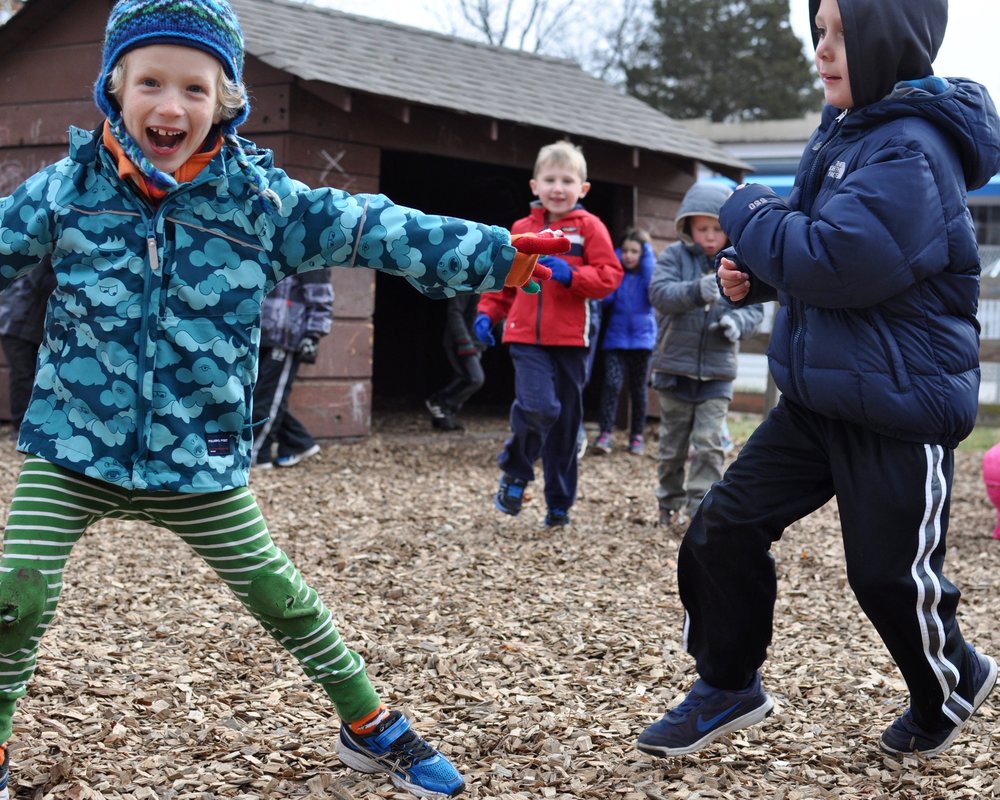 It is true that the winter months are the times when we see the most illness. It's flu season, it's cold season, everyone's noses are dripping and little mouths are coughing. But unless your child is very ill, it is still important for him to get outside and running around even in the cold weather. The

 Playing outside in the winter months, even just for half an hour, can help boost Vitamin D levels, which in turn increases the amount of serotonin in the brain, and together these things can help boost a person's mood. Even a little bit of sunshine can help with that!


 Another reason to get your children outside during the cold months is for socialization! There is a kind of play that happens outdoors that is different from the kind that happens inside. Children are more creative, imaginative, and active outdoors, especially when their friends are available to join them!


 Of course, the obvious reason to get outside even when the weather is cold is for the exercise! It's important to remember that children are still growing during this time, and benefit greatly from moving their muscles and getting their hearts pumping. According to the

 And finally, a good reason to get outside during the cold months of the year is for the connection to nature and the observations that cannot be made at other times of the year. The child above fell onto the wood chips, then happened to look down and discover some frost that had formed on one of the larger wood chips. He looked at the ice crystals for some time, clearly happy and interested in what he had discovered, before shouting for his friends to come see it for themselves.


 As Villa does, just bring your tissues with you!And parents, don't forget to send your children to school with warm coats, hats, gloves, boots, scarves, and even snow pants for the winter weather. Also, Villa encourages your children to bring sleds and other snow-related fun things to share with their friends on extra snowy days! So over winter break, be sure to get outside and play!We'll have some great new blog posts up for you after holiday break. Happy New Year!

 While a stool at the kitchen counter works well, a small child-sized table is even better! We carried this one into the kitchen for these two Villa primary students. Having a small table at which to work makes it possible for more than one child to move freely around, and to easily measure, stir, and break eggs at a comfortable height. They're also steadier on their feet!Another tip: set up all the necessary measuring tools and ingredients before asking your child to join you. It gives a good visual of what all is needed, as well as saving time. Show them each step, then let them do it on their own. It's okay if the measurements here are a little off!
 Cracking eggs: while your child is still learning how to do this, let him crack the eggs into a small container rather than directly into the recipe mixture. That way, if any eggshells find their way in, you can easily fish them out before adding them to the mixture and losing them.


 Another tip: if you have more than one child helping, be sure to divvy up the tasks so that everyone gets a chance to do each step. We alternated adding dry ingredients and using the whisk to mix it up.
 A true Montessori moment: cleaning up without being asked!
 Another opportunity for independence is operating the stand mixer: under supervision, let your child experiment with the different speeds (of course, remind her to never ever put her fingers into the mixing bowl while it is going!).And anything involving an opportunity to get hands messy is a plus…


 … especially when the mess tastes as great as these gingerbread cookies!Happy Holidays, and we hope you enjoy this recipe!


 Donning hard hats for safety, the children were taken through in groups to make the tours more manageable.


 Questions were asked and answered, such as "Will we get stuck in any of the concrete?" and "No, all the concrete has dried and hardened." First, the necessary details!


 Above, one of the workers showed the children where the fireplace will be -- somewhere around here, in the library. Being within the rooms was very special -- the building is so much larger once you step inside! Also, the windows really are huge!


 This worker also pointed out where the play yard will be. The children gathered around to peak out the window and imagine the space -- a practice that is getting easier and easier as the building comes along.

 Here is the west side of the building, and below, the north side.
 Thank you, BSI Constructors, for taking your time to show the children around, and for your patience and positivity while answering their questions!


 There was still plenty of color in the gardens tucked in around campus at the beginning of December. Those flowers held out far longer than usual! It was such a special treat to see them still green and pink and purple before the frost came mid-month.


 As mother nature does her thing, the cold and frosty weather has arrived...

 We look forward to all of the fun holiday activities that will take place within the Villa classrooms — from celebrations to practice for the big performance, to pajama day and beyond! We hope you and your families are cozy and well!

