The Best St. Louis Summer Camps

 Are you ready for summertime? It's just around the corner for Villa di Maria students - can you believe it's the very last week of school?! If the end of the school year has snuck up on you (as it has for many of us), and you're scrambling for summer camp ideas, rest assured that the St. Louis area is full of them. Below, a comprehensive list of the best summer camps in the area.
  Camp PegnitaWe may be biased, but we are very proud of Camp Pegnita- not only its rich history (it has been going strong for 70 years!) but also its dedication to keeping many of the great camp traditions alive over all these years. This is an old-school camp in which children spend nearly every moment of the day outdoors, enjoying archery, games and weekly themes, swimming, and more on the beautiful 6 acres of Villa di Maria's wooded green campus. This year is going to be even better, with new facilities and a beautiful big playing field!
 ArtScope St. Louis's Art of NoiseArtScope's most popular 4-day camp, Art of Noise, will explore sound, the idea of music, instrument making and alternative instruments in Tower Grove Park from 9am to 3pm daily for children ages 5 - 11. Sign up soon, this camp starts May 30th and runs through June 2nd! Check out ArtScope's other summer camps, including Planes, Trains, and Rickshaws, Magic and Mystery Camp, Printastic, Culture Club, and more here.
 The Magic House Summer CampsThe Magic House offers three different summer camp themes from which to choose: Electrify and Energize, Booms and Blast Offs, and Fantastic Feats. They also offer art-based sessions: Camp Artist and Camp Make-It. For the 4-5 year age range, there are Storybook Adventures, Fantastic Five Senses, and Naturally Curious sessions. Check out more here.
 Chess Summer CampSt. Louis is home to many Grandmasters (the highest level chess players), and we are lucky to be close to the Chess Club and Scholastic Center of Saint Louis, a non-profit, educational organization committed to making chess an integral part of the St. Louis community. Chess is a valuable educational tool that helps teach important lessons including problem solving, critical thinking, sportsmanship, patience and goal setting. Camps are offered all day, or mornings or evenings only. Check out the details and register here.
 Circus Harmony Performance CampLocated at City Museum, Circus Harmony Summer Performance Campis an amazing experience. Campers learn actual circus arts, including trapeze, juggling, wire-walking, and more! Then, these aspiring circus stars perform in the Circus Harmony ring daily during the second week of each session. After seeing these guys in action at our annual Circus Night, we're ready to sign up!
 COCA Summer Arts CampCOCA is one of St. Louis' premiere organizations for new artists and masters alike, creating an innovative environment for campers to learn, perform and appreciate the arts. This summer, the camps available include poetry, dance, drama, sculpture, songwriting, videography and much more. Options include week-long full or half-day sessions. COCA camps are held at two locations: at COCA's University City campus and in Creve Coeur at Whitfield School. Before and After Care is available. Check out the camp guide here.
 Dave Simon's Rock SchoolFor the musically-inclined, Dave Simon's Rock School is the place to go! Campers are placed into rock bands as they work together to record and prepare for their end-of-camp concert. Campers take private lessons on their instruments as well as every instrument in the band (guitar, bass, drums and piano). Summer Camp also includes workshops in songwriting, improvisation, and percussion. They have programs for kids ranging in age from 4 to 18. Check it out here.
 Endangered Wolf Center Summer CampFor your animal lover, check out The Endangered Wolf Center for their summer camp program. Located in Eureka, this camp provides children with the ability to explore the world of the wolf by visiting these amazing animals, playing fun games to learn about wolf behavior, and making crafts. Exciting hikes explore nature and some of the interesting places at the Tyson Research Center. There is also an option for younger campers, ages 4 -5, through the new Summer Pup Camp. Read more here.
 J Day CampsIn addition to swimming, lunch, field trips, and traditional sports, arts, and gymnastics, the J has added STEAM (Science, Technology, Engineering, Arts & Math) Academies at and in partnership with Saul Mirowitz Jewish Community School. The J offers eleven weeks of camps and programs for kids ages 3-10th grade. Sign up here.
 Laumeier Sculpture Park Summer Arts CampA place that has become very near and dear to our hearts, Laumeier provides opportunities for campers to learn about artists throughout history, explore Laumeier's woodland trails and find inspiration in the artworks on view for drawing, painting, sculpting and more.Each weekly session features a different theme, and an Extended Day option is available for full-day sessions. Summer Art Camps are taught by local, experienced Artist-Instructors and are structured to encourage artistic development and self-expression through social and individual skill-building experiences. Check it out here.
 Summer Science Blast at St. Louis Science CenterSummer Adventures include flying a real airplane, building a robot, developing your own video game and much more! They offer eight weeks of programming for Pre-K through 10th grade. Half-day, full-day, and flexible extended care options.Whatever you decide to do this summer, be assured that there is plenty to do in our neck of the woods!


 Photo credit: St. Louis Post-Dispatch


 Photo credit: St. Louis Post-Dispatch
 Photo credit: Gateway Off-Road Cyclists
 Last, but not least, don't forget that a little dirt (or a lot of dirt, in this case) doesn't hurt!

 Another way to boost the nurturer in your child is to help him identify feelings beyond happy, sad, angry. The emotional landscape rich and nuanced; consider a wide range of "feelings" words to shed light on a situation: frustrated, calm, surprised, envious, thankful, concerned, nervous, excited, discouraged, uneasy, embarrassed, suspicious, curious, enthusiastic, hopeful, brave, loving, and so many more. Children often struggle to identify what they're feeling, which makes communicating their feelings--beyond whether they feel good or bad about a situation--extremely difficult. Helping them identify what emotion they feel and why gives children the linguistic tools needed to navigate increasingly complex interpersonal relationships.One very effective way to encourage compassion in your child is to catch her being compassionate and praise her for her understanding, kind behavior. This can be as simple as stating, "Wow, that was so thoughtful and kind of you to offer your friend a hug and a tissue when she was crying. That must have made her feel very loved." Helping others feels good, and this feeling can be enhanced when an adult in the child's life notices! But, don't overdo it. An adult constantly stepping in to praise a child for kindness quickly becomes a distraction and can ultimately detract from the natural situation and feelings involved.Another important piece of fostering empathy is to limit screen time for young children. Aside from the many recent studies showing brain changes in young children who stare at screens for too many hours of the day, there is the commonsense knowledge that too much screen time takes time away from other important things, such as actual real-life social interactions with others. Face-to-face interactions with peers and family members provide a multitude of crucial opportunities for children to learn from conflict, as well as to develop empathy for others. Doctors recommend
  All of these acts seek to develop the whole child, to recognize in him the ability to affect positive change in the world, to see her as a global citizen, and to set up our world for a better future. As "…the child begins to become conscious of right and wrong, this not only as regards his own actions, but also the actions of others…..moral consciousness is being formed and this leads later to the social sense." (The Absorbent Mind, p. 177)For additional reading on how to cultivate empathy in children,

 In the KitchenFor younger children, placing glasses, plates, bowls, and silverware within reach enables them to help themselves to breakfast in the morning, and can encourage them to set the table for dinner. If hand towels are in a low drawer or basket, they can clean up spills more easily, and put away laundry once it's been folded.
 For a child who enjoys watercolors, a small shelving unit meant for use as a spice rack can double as windowsill storage for paint, brushes, cloths, a jar for water, watercolor pencils, and watercolor paper stacked below.


 In the Living Area/Community SpaceShelving can support most art supplies, tools, and interesting items. If you are lacking space, these items can be removed and switched out to keep things interesting. Items should not be crowded together, but spaced out so as not to overwhelm. Discuss with your child expectations that, as with school, each item should be returned to its place when he is finished using it. Sorting like-items helps with this. For instance, puzzles can be stacked together, a science shelf can hold science materials, favorite books can be in a basket by the couch for easy access.

 In the Bathroom/WashroomA sink in the home is not like a sink in the Primary Montessori classroom! It may be just the right height for the adults in the family, but much too high for the young child. A step stool is necessary to encourage independent hand-washing and brushing teeth. If you are sharing a bathroom, there are plenty of fold-up versions of step stools that easily collapse when a young child is not using it. A nail brush is within reach for those grimy nails — now getting them to use it is another story!


 Binoculars set by a back window encourages bird watching. A guide book, some collected feathers, and other wildlife can go alongside to enhance the experience!In the Dining Room/Community SpaceChild-sized furniture is ideal, if possible. A low work table serves as a place to eat, a place to draw or paint or write stories, even a place to do crafts or flower arranging or prep foods for dinner. If chairs are lightweight and child-sized, they are easy to move around, another way to promote independence. If a dustpan and brush are readily available, a child can clean up messes and crumbs without needing help. Same with aprons!A great resource for starting Montessori in the home from the very beginning is our very own Montessori Guide, Maria Burr, who runs the


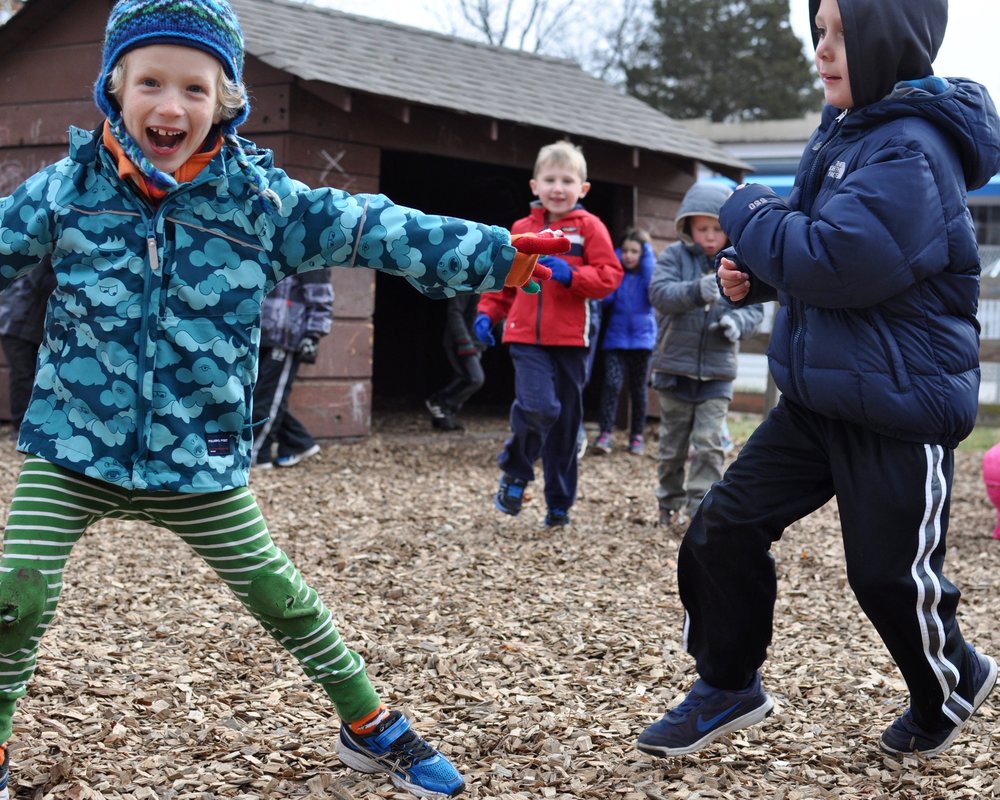 It is true that the winter months are the times when we see the most illness. It's flu season, it's cold season, everyone's noses are dripping and little mouths are coughing. But unless your child is very ill, it is still important for him to get outside and running around even in the cold weather. The

 Playing outside in the winter months, even just for half an hour, can help boost Vitamin D levels, which in turn increases the amount of serotonin in the brain, and together these things can help boost a person's mood. Even a little bit of sunshine can help with that!


 Another reason to get your children outside during the cold months is for socialization! There is a kind of play that happens outdoors that is different from the kind that happens inside. Children are more creative, imaginative, and active outdoors, especially when their friends are available to join them!


 Of course, the obvious reason to get outside even when the weather is cold is for the exercise! It's important to remember that children are still growing during this time, and benefit greatly from moving their muscles and getting their hearts pumping. According to the

 And finally, a good reason to get outside during the cold months of the year is for the connection to nature and the observations that cannot be made at other times of the year. The child above fell onto the wood chips, then happened to look down and discover some frost that had formed on one of the larger wood chips. He looked at the ice crystals for some time, clearly happy and interested in what he had discovered, before shouting for his friends to come see it for themselves.


 As Villa does, just bring your tissues with you!And parents, don't forget to send your children to school with warm coats, hats, gloves, boots, scarves, and even snow pants for the winter weather. Also, Villa encourages your children to bring sleds and other snow-related fun things to share with their friends on extra snowy days! So over winter break, be sure to get outside and play!We'll have some great new blog posts up for you after holiday break. Happy New Year!

 While a stool at the kitchen counter works well, a small child-sized table is even better! We carried this one into the kitchen for these two Villa primary students. Having a small table at which to work makes it possible for more than one child to move freely around, and to easily measure, stir, and break eggs at a comfortable height. They're also steadier on their feet!Another tip: set up all the necessary measuring tools and ingredients before asking your child to join you. It gives a good visual of what all is needed, as well as saving time. Show them each step, then let them do it on their own. It's okay if the measurements here are a little off!
 Cracking eggs: while your child is still learning how to do this, let him crack the eggs into a small container rather than directly into the recipe mixture. That way, if any eggshells find their way in, you can easily fish them out before adding them to the mixture and losing them.


 Another tip: if you have more than one child helping, be sure to divvy up the tasks so that everyone gets a chance to do each step. We alternated adding dry ingredients and using the whisk to mix it up.
 A true Montessori moment: cleaning up without being asked!
 Another opportunity for independence is operating the stand mixer: under supervision, let your child experiment with the different speeds (of course, remind her to never ever put her fingers into the mixing bowl while it is going!).And anything involving an opportunity to get hands messy is a plus…


 … especially when the mess tastes as great as these gingerbread cookies!Happy Holidays, and we hope you enjoy this recipe!

 Thanksgiving with Me, by Margaret Willey, illustrated by Lloyd BloomA heartwarming, joyous story about the anticipation a little girl feels as she anxiously awaits the arrival of her six uncles. To pass the time, the little girl asks her mother to tell her a story about each uncle. This story is about getting past the "what to wear" and "what to make" surface issues of Thanksgiving and back to the cherished family stories, which is what brings the most joy.
 The Thanksgiving Door, by Debby AttwellThis is a cross-generational celebration that honors inclusion and tolerance of those different from ourselves. When an older couple burn their own Thanksgiving dinner, they head out to eat for the holiday and come across an open door. Inside, they meet an immigrant family celebrating their own version of Thanksgiving. A wonderful read for those who want to share open hearts and open minds with their children. Though this book is now out of print, many libraries still keep a copy or two.
 Gratitude Soup, by Olivia RosewoodThis story has such a wonderful message! It teaches children that they can carry gratitude in their hearts at all times. Violet the Purple Fairy, the main character, makes gratitude soup by conjuring up all of the people, places, things, and experiences she is grateful for, then puts them into an imaginary pot of soup. The book incorporates pretend play and catchy rhymes for young children. The mixed collage and watercolor art in this book are a beautiful bonus.
 Did I Ever Tell You How Lucky You Are? by Dr. SeussA tale of all of those who are less fortunate, but still full of plenty of the silliness characterized by Dr. Seuss, this book is another good one for practicing perspective-taking and empathy for others. This story takes the idea that if you're having a bad day, remember that it could always be worse, and lifts it to a whole new level!
 An Awesome Book of Thanks, by Dallas ClaytonThis is an awe-inspiring book full of thank-you's to things, places, people, and phenomena that you've never imagined or considered thanking before. It is the biggest thank you with some pretty great illustrations. Great for any age.
  The Thankful Book, by Todd ParrThis is the perfect book for the very young child to recognize the feeling of gratitude. From Todd Parr himself: "There are lots of things to be thankful for. Try to remember some of them every day!"Happy reading!


 The open-ended play that results from loose parts — the sticks and logs and things found in nature, provided by nature itself, allows for deep creative experimentation: the crucial element being the children's freedom to adapt the materials in a large variety of ways. These logs can become structures, machines, vehicles, absolutely anything a child (or group of children) decides.


 The power of loose parts lies in its infinite possibilities. It does not dictate a story or purpose; the child does so.


 If you are interested in creating more loose parts play for your child, consider the following in your back yard: stones of varying size, slices of wood rounds, sticks, pinecones, sand, wood chips, chalk, gravel, acorns, planks, tubes, and wheels.For indoors: popsicle sticks, dominos, wood blocks, felt balls, yarn, pipe cleaners, marbles, cardboard tubes, washers, buttons, shells, magnetic building tiles, strips of fabric (silk, wool, cotton), and even dried seeds or beans!Happy playing!

 Pouring, mixing (with her hands, with a whisk, and with a spoon or rubber scraper)
  Peeling using fingers (egg, garlic, mandarin orange) or using a peeler
  Cutting and chopping (*make sure your child is using knives and other sharp tools properly, putting her hand in the right place. Remind her again and again that no fingers should be on the cutting board)
  Grating, kneeding, scooping, egg cracking (be sure to have a full carton of eggs to sacrifice the first day your child tries this… and plan to have a crunchy omelet to eat that day!), spreading, and shelling peas
  Washing vegetables, washing dishes, washing table
  And, the best part: using the senses in the kitchen: tasting, touching, and smelling!Now for the recipe! Sophie has shared a typical easy French recipe: Carottes Vichy (Vichy Carrots). This recipe uses many skills: peeling with fingers and with a peeler, washing, cutting leaves, chopping, cutting, pouring, and mixing.
 Vichy CarrotsNo specific proportions here, just prepare according to your own taste: parsley, garlic, carrots, salt, ground pepper, and olive oil.First, make a "persillade," (chop together parsley and garlic). Next, cut carrots into rounds. Mix everything, then sauté in a pan with olive oil, salt, and pepper.Et voila! Bon appetit!Thank you, Sophie, for inspiring us all to include our children in the kitchen — such a wonderful thing to do together as a family!


 What is happening here? Coordination with one's own body in addition to coordinating with others' bodies, balance, teamwork, joy, and relaxation all in one!
 Imagination, abstract thinking, and a self-imposed time-out: this child was upset and went to be by herself for a few moments. Her friend, standing, checked on her and took a position of protector. They ran off together minutes later.
  Pure joy!
 Simply observing children at recess is enough to see the evidence of this complex and important part of a child's day. What an honor to be a fly on the wall! Let those kids play!

 All of the children have a part to play and a story to make of themselves in each class. But some roles are hard to fill and take a rarer set of qualities. Sometimes, in some classes, they remain unfilled because no one is up to it, and the classroom experience as a whole is less rich and a little less complete. The contrarians, as I think of them, are scarce. Their special gifts have often been thought of and treated by the culture at large as burdens instead of opportunities — even when they are yet children! — so I prize those ones especially.Thank you for [your contrarians].And thank you, Anna, for never failing at the magical ability to see the good in every child. Your perspective and words are truly inspiring!